
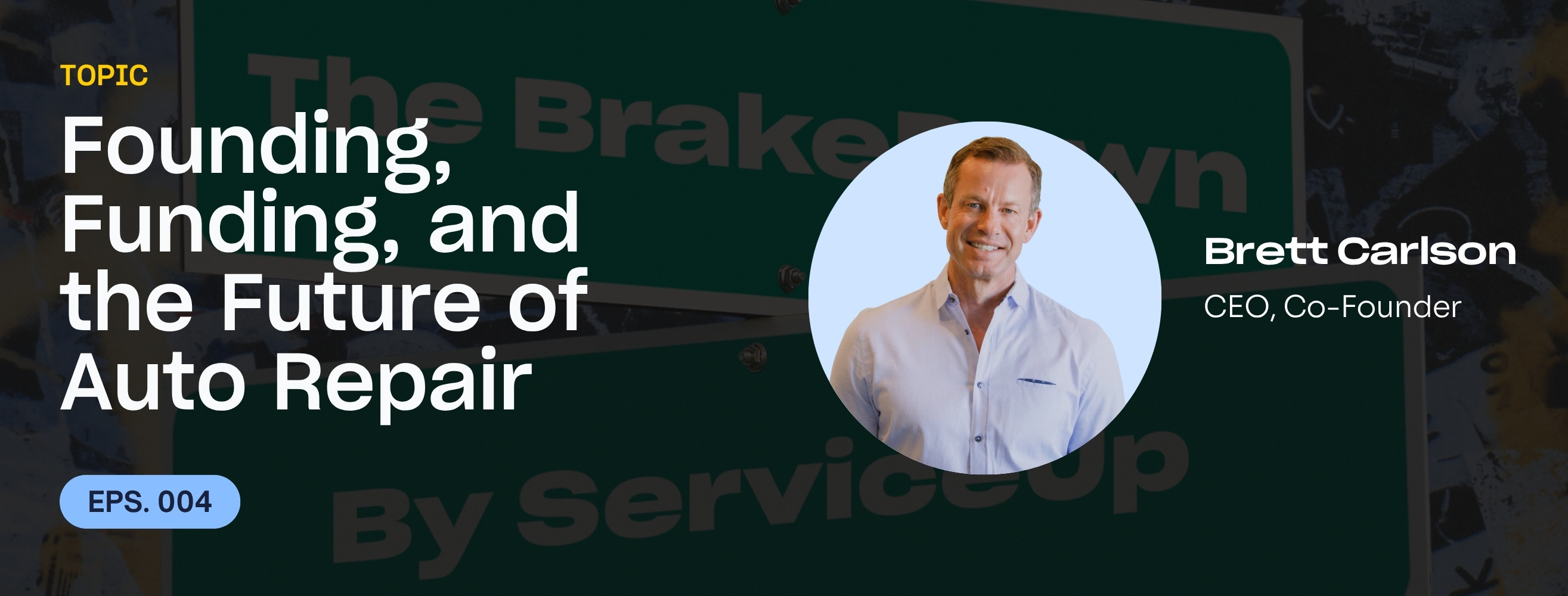
Kam Thandi sat down with Brett Carlson, CEO and co-founder of ServiceUp, for this episode of The BrakeDown. Brett covers how he ended up in auto repair without planning to, what building a company in a fragmented industry actually takes, and why he treats culture as a first order problem rather than a perk.
The rest of the conversation runs through the fundraising process, where automation and AI are headed in repair, and the leadership lessons that came out of the harder decisions.
Why repair is a hard industry to build in
Most supply chains have a manageable number of counterparties. Vehicle repair has tens of thousands of independent shops, each with its own management system, estimating tool, labor rate, parts sourcing habits, backlog, and preferred way of being contacted. Two shops eight miles apart can run on software that has never exchanged a record.
Put a fleet on top of that. Vehicles in a dozen states means dozens of shops, no shared data, and no clearinghouse in the middle. Status lives in phone calls, text threads, and an inbox. The question "where is my van and when is it coming back" takes twenty minutes and three calls to answer, and by the time you have the answer it is stale.
That fragmentation is why repair has resisted the software wave that reshaped dispatch, telematics, and fuel. There was never a single system everyone plugged into, so the coordination stayed manual. Anyone building here has to meet shops where they already work rather than ask forty thousand businesses to change tools.
Takeaways from the episode
- The auto repair ecosystem is fragmented and overdue for modernization.
- The early years of a startup come with real difficulty and a steady supply of moments nobody planned for.
- Raising money for a niche market is hard, and worth doing.
- Company culture is a top priority at ServiceUp rather than a hiring page.
- The future of repair involves more automation and tighter integration with the vehicle itself.
- Leadership means making difficult calls with compassion.
- Repair is still early in its technological evolution.
- Building something that lasts takes drive and an actual intent to improve the thing you found.
What this means for your operation
If repair is early in its technology curve, the practical consequence is that vendor maturity varies more than the marketing suggests. Two providers can describe the same capability and mean completely different things, one meaning an API and the other meaning a person retyping updates into a portal once a shift.
The gap matters most at the handoffs. A provider that batches its updates into one evening sync is fine until an estimate lands at 9am and sits until 5pm, which is a full working day added to a repair for no reason anyone can point at. The same gap shows up when a shop misses a completion date and nobody finds out until the driver calls about a vehicle that was supposed to be back.
Five questions sort that out quickly on a vendor call.
- Which of my systems do you write back into, and by what method: API, webhook, or a file someone uploads?
- When an estimate arrives, who reviews it against my repair policy, how fast, and what happens to the line items that fail?
- What happens when a shop misses the ECD (estimated completion date)? Who finds out first, and how soon do I know?
- Can I see median time in shop by shop and by repair type without requesting a report?
- If I bring my own shops, do they keep working with me on your platform, or do I have to move that volume?
Where to skip to
- 00:00 Founding ServiceUp
- 07:37 Raising money for a niche market
- 10:10 Building a team and a company culture
- 15:16 The future of auto repair: automation and AI
- 18:02 Disruption in the auto repair industry
- 22:29 Leadership lessons and personal growth
ServiceUp is the agentic repair platform for modern fleets. You bring the system of record. We bring the system of repair, which means intake, shop routing, estimate review, and the follow up run by agents inside the systems your team already uses. More at serviceup.com/fleets.

.png)

.png)


